Updated by
Duke is the founder of Aviation Careers. He's Primarily an Airline Pilot in Australia with experience in Charter and Aeromedical operations. He is passionate about improving accessibility for younger generations in aviation and increasing safety throughout the industry.
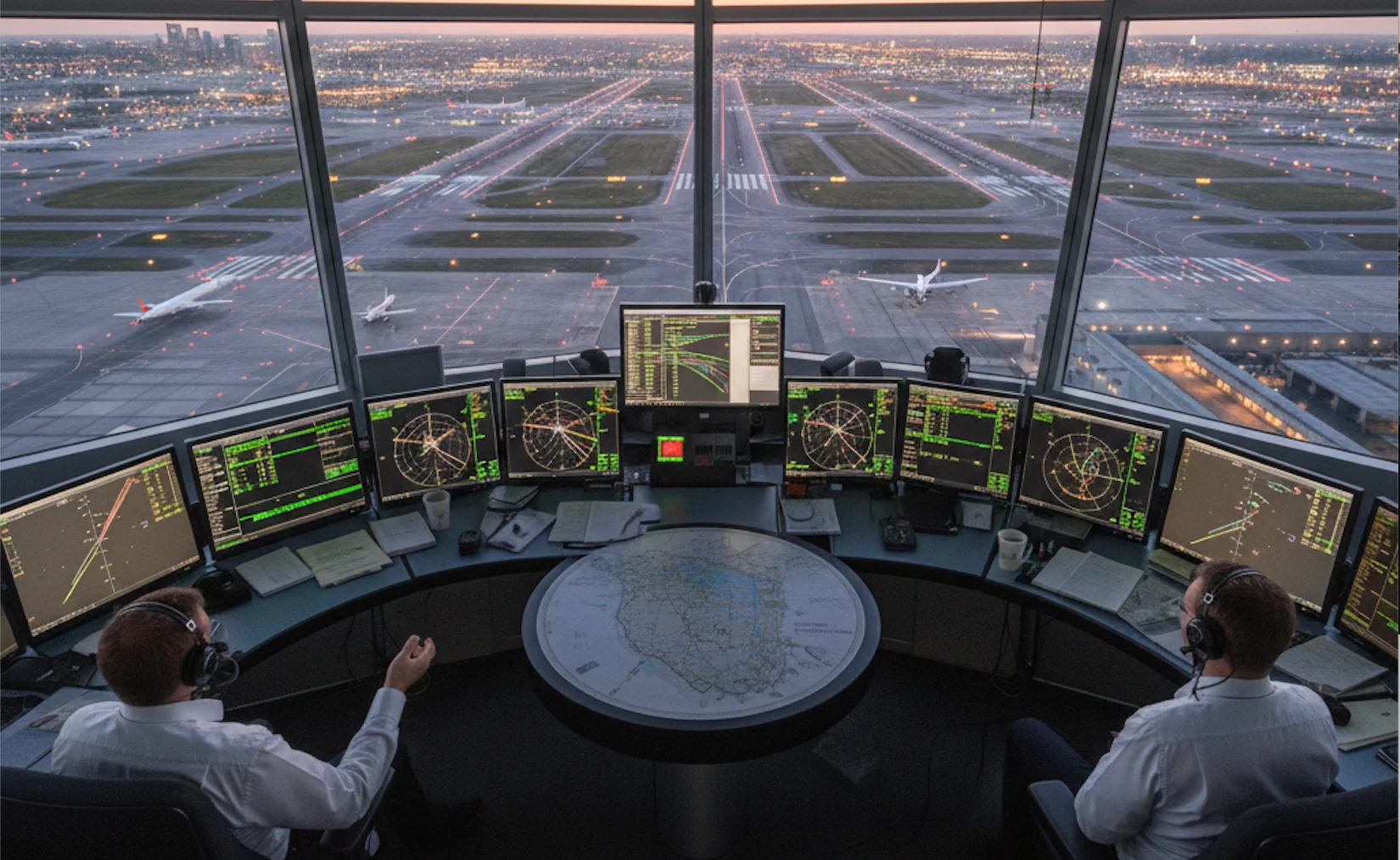
If you've ever watched a radar screen pulse with dozens of blips and thought someone has to be keeping all of that organised — you'd be right. Air traffic controllers (ATCs) are the unseen architects of Australian airspace, and the pay reflects exactly how seriously we take that job. Whether you're researching a career change, curious after a conversation at the pub, or weighing up whether three years of training is worth it financially — this guide lays it all out with real numbers, real roles, and no fluff.
Who Employs Air Traffic Controllers in Australia?
Before we get into the dollars, it's worth knowing who signs the paycheques. The vast majority of air traffic controllers in Australia work for Airservices Australia — the government-owned corporation responsible for managing civil air traffic across the country. They operate 29 airports, manage over 4 million aircraft movements each year, and employ roughly 1,000 operational controllers.
Their enterprise agreement — updated in 2024 — sets a transparent, level-based salary structure, which makes pay research in this industry unusually straightforward. There are no secret negotiations or vague "competitive salary" listings. The numbers are published. Below, we walk through all of them.
How the ATC Classification System Works
ATC careers at Airservices Australia follow a clear classification structure with defined levels from trainee right through to senior supervisor. Progression through the levels is based on a combination of time served, additional operational endorsements, and demonstrated competency.
Think of it like a staircase — each step reflects a meaningful increase in responsibility, and the pay jumps accordingly. There are four broad phases:
Training phase — Ab Initio and Field Trainee
Developmental phase — Levels 1–2 (newly endorsed through early career)
Operational phase — Levels 3–10 (experienced through senior controllers)
Specialist/Supervisory phase — UTS, CSS/SS, and Supervisory roles
The figures below are base salaries at commencement of each classification, sourced directly from the Airservices Australia ATC Classification and Base Salary Table (Enterprise Agreement 2024–2027). Built-in increases of 3.8% at 12 months and 3.4% at 24 months apply across every level.
ATC Salaries by Role and Level
Ab Initio Trainee — $60,000/year
Every ATC career in Australia begins here. The Ab Initio phase takes place at the Airservices Australia Aviation Learning Centre in Melbourne, where recruits complete a 12–18 month program covering radar theory, separation standards, meteorology, and simulation-based exercises before ever touching a live traffic feed.
What the role involves: Full-time classroom and simulator training. No live traffic management. Think of it as the foundational year of a very high-stakes degree — one you get paid to complete.
Key tip: Being paid $60,000 to learn one of the most technically demanding jobs in the country is a genuinely competitive arrangement. Factor in that there are no HECS debts or tuition fees involved, and the value proposition becomes even clearer.
Field Trainee — $85,952/year
Once you've cleared Ab Initio training, you progress to Field Trainee — working under direct supervision at an actual Airservices Australia facility handling live traffic. This is where theory meets reality, and the near-$26,000 salary jump reflects that step up in responsibility.
What the role involves: Supervised live traffic management, working toward your unit endorsement at a towered aerodrome, terminal control unit, or en route centre. You're doing the job — just with a qualified controller watching over your shoulder.
Important note: Field Trainee postings are assigned by Airservices Australia based on operational requirements. You may not always end up at your preferred facility, particularly in early postings.
Level 1 — $116,990/year
Congratulations — you're a fully endorsed Air Traffic Controller. Level 1 marks the point at which you're independently managing traffic without direct supervision. The salary surpasses $116,000 from day one of endorsement.
What the role involves: Independent management of a sector or position at your endorsed facility. For some, this might be a regional aerodrome tower. For others, a terminal control position at a major capital city airport. The real job — with all its complexity, adrenaline, and satisfaction — starts here.
Levels 2 Through 5 — $131,317 to $171,107/year
This is the core of the ATC career — the progression years where experience accumulates, additional endorsements are earned, and salary climbs steadily. Movement through these levels typically reflects time served combined with demonstrated performance and the acquisition of new position endorsements (such as approach control, en route, or additional aerodrome positions).
Level | Base Salary (Commencement) |
|---|---|
Level 2 | $131,317 |
Level 3 | $145,641 |
Level 4 | $158,373 |
Level 5 | $171,107 |
Most working controllers in Australia sit somewhere in this band. When shift penalties, overtime, and allowances are added, total remuneration for a mid-career controller regularly exceeds $200,000 annually — placing ATCs firmly in the top tier of Australian income earners.
Strategic tip: Controllers who pursue additional endorsements across multiple positions (such as holding both aerodrome and approach endorsements) tend to progress faster through these levels and attract more overtime opportunities.
Levels 6 Through 10 — $186,229 to $226,955/year
Senior operational controllers. By this point you've accumulated years of complex traffic management experience, likely hold endorsements across multiple positions, and are a cornerstone of your facility. Salaries in this bracket are competitive with senior management roles across most industries — and unlike many corporate positions, they come with generous shift allowances on top.
Level | Base Salary (Commencement) |
|---|---|
Level 6 | $186,229 |
Level 7 | $198,961 |
Level 8 | $211,696 |
Level 9 | $218,858 |
Level 10 | $226,955 |
Specialist and Supervisory Roles — Up to $266,901/year
At the top of the classification structure sit the specialist and leadership roles. These positions require deep operational expertise and typically encompass training responsibilities, mentoring junior controllers, operational oversight, and managing complex high-traffic environments at Airservices Australia's busiest facilities.
Role | Base Salary (Commencement) |
|---|---|
Unit Training Supervisor (UTS) | $247,968 |
Chief Sector Specialist / Sector Specialist (CSS/SS) | $247,968 |
Sydney CSS / Supervisor | $266,901 |
The Sydney supervisor premium reflects the sheer complexity of managing one of the Asia-Pacific's busiest airspace environments. At this level, total packages including shift allowances can comfortably exceed $300,000 annually.
Important note: Per the 2024–2027 Enterprise Agreement, the Sydney TTCU and Sydney CSS/Supervisor classifications will cease to apply to new employees from 1 July 2025 and are being grandfathered for existing qualifying employees. Structures in this tier are evolving — worth keeping an eye on with future enterprise agreement negotiations.
What Else Boosts Your Take-Home Pay?
Base salary is just the starting point. ATC remuneration at Airservices Australia is significantly enhanced by several additional components:
Shift penalties — ATC is a 24/7 operation. Saturday, Sunday, night, and public holiday shifts attract penalty rates that can meaningfully increase annual income, particularly for controllers at busy facilities with complex rosters.
Overtime — With Airservices Australia managing a well-documented staffing shortage, overtime opportunities are plentiful for controllers willing to pick up additional shifts.
On-the-Job Training Instructor (OJTI) allowances — Controllers who are endorsed to train Field Trainees receive additional allowances for each training shift conducted. It's one of the more accessible ways to boost income without changing classification level.
Additional endorsements — Holding qualifications across multiple positions generally supports faster progression through the classification levels and unlocks more shift flexibility.
Location Matters: How City Affects Your Earnings
While the Airservices classification system is nationally consistent, the total remuneration picture varies by location due to traffic complexity, roster patterns, and the number of available positions and endorsements.
Sydney is consistently the highest-earning posting for experienced controllers, reflecting the complexity and intensity of managing Australia's busiest airspace. Controllers at Sydney Terminal Control Unit (TCU) and Sydney Airport tower positions typically report the highest total packages.
Melbourne is comparable, with the en route centre (Tullamarine) being one of the most operationally complex and well-staffed facilities in the country.
Brisbane and Perth sit in the middle — strong earning potential, particularly for controllers who accumulate multiple endorsements across the combined aerodrome and TCU functions.
Darwin and regional postings (Cairns, Mackay, Alice Springs) often appeal to controllers seeking lifestyle factors alongside competitive salaries, with lower costs of living helping to offset slightly lower total packages.
How Does Australia Compare Globally?
Very well. Australia consistently ranks among the top three best-paying countries in the world for air traffic controllers — sitting alongside the United States and Switzerland. Base salaries that routinely exceed $130,000 for newly endorsed controllers, combined with a strong shift penalty system, put Australian ATCs ahead of their counterparts in the UK, Canada, and most of Europe when adjusted for cost of living.
For international controllers considering a move to Australia, it's worth noting that Airservices Australia does periodically recruit internationally endorsed controllers through validation pathways — though the process is competitive and operationally demanding.
Is the Pay Worth It? The Full Picture
The short answer: yes — but with eyes open.
The salary is exceptional. Getting there, however, requires clearing a selection process with an acceptance rate of roughly 2–5% of applicants, completing 12–18 months of unpaid-training-equivalent study (albeit at $60,000/year), and then spending years building endorsements in what is genuinely one of the most mentally demanding professions in the country.
The ongoing requirements are also real: Class 3 medical certification must be maintained throughout your career, concentration demands are extreme, and the consequences of errors — while well-managed through robust systems and teamwork — carry weight that most jobs simply don't.
For the right person — someone who thrives under pressure, is energised by precision and problem-solving, and wants a career that genuinely matters — the financial rewards are substantial, the career pathway is crystal clear, and the job satisfaction among experienced controllers is among the highest of any profession in Australian aviation.
The Application Process: What to Expect
Airservices Australia typically opens ATC recruitment 1–2 times per year, and the process is thorough. Here's what the pathway looks like:
Online application and eligibility check — Australian citizenship or permanent residency required, along with minimum educational requirements (typically Year 12 with strong maths and English).
Cognitive aptitude testing — A multi-stage assessment covering spatial reasoning, multitasking, numerical processing, and working memory. This is the major filter — preparation matters.
Psychological assessment — Personality and behavioural profiling to assess suitability for high-pressure, safety-critical work environments.
Panel interview — Competency-based interview with Airservices Australia assessors.
Medical examination — Class 3 aviation medical with a CASA-approved Designated Aviation Medical Examiner (DAME). See our Complete Guide to Aviation Medical Certificates in Australia for full details on what this involves.
Security clearance — Australian Government security vetting required before commencing training.
Key tip: The cognitive aptitude tests are the biggest hurdle for most applicants. Practice tools are available online that simulate the style of testing used in ATC selection. Treat preparation for these the same way a pilot candidate would treat exam preparation — it makes a measurable difference.
Your Next Steps
If an ATC career is on your radar (pun intended), here's how to position yourself well:
Book a Class 3 medical early — Discover any potential issues before investing time in the application process. A Class 3 medical is less onerous than a Class 1, but it's still a gating requirement.
Monitor Airservices Australia's careers page — Recruitment rounds open and close quickly. Set up job alerts and check back regularly.
Browse ATC roles on Aviation Careers — Occasionally, ATC and ATC-adjacent positions (including roles with Defence, RAAF, and contracted service providers) are listed here.
Staying Informed About Aviation Careers
ATC salaries are just one piece of the picture. If you're exploring your options across Australian aviation more broadly, these resources will help:
How to Become an Air Traffic Controller in Australia — Complete training guide and career pathways
Your Complete Guide to Aviation Medical Certificates in Australia — Everything you need to know about Class 1, 2, 3, and 5 medicals
The Definitive Guide to Pilot Recruitment in Australia 2026 — Airline-by-airline breakdown if you're weighing up the pilot path
Aircraft Maintenance Engineer Career Guide — Qualifications, salary, and jobs for the engineering side of aviation
Ready to Take Flight? Explore Aviation Career Opportunities
Whether you're just starting your research or ready to take the next step, Aviation Careers connects aviation professionals with Australia's leading employers across every sector — including air traffic management, flight operations, engineering, and more.
Browse All Aviation Jobs →
Find positions for:
Air traffic controllers
Commercial and charter pilots
Aircraft maintenance engineers (LAME)
Flight instructors
Cabin crew
Ground crew and operations staff
Aviation management roles
Discover Aviation Companies Hiring Now →
Connect with leading employers including Airservices Australia, Qantas Group, Virgin Australia, regional carriers, helicopter operators, and aviation service providers across Australia.
Salary data sourced from the Airservices Australia ATC Classification and Base Salary Table (Enterprise Agreement 2024–2027). Total compensation figures — including shift allowances, overtime, and OJTI payments — vary based on facility, roster patterns, and individual endorsements. Always refer to the current Enterprise Agreement and Airservices Australia's recruitment materials for up-to-date information.
Last updated: February 2026